


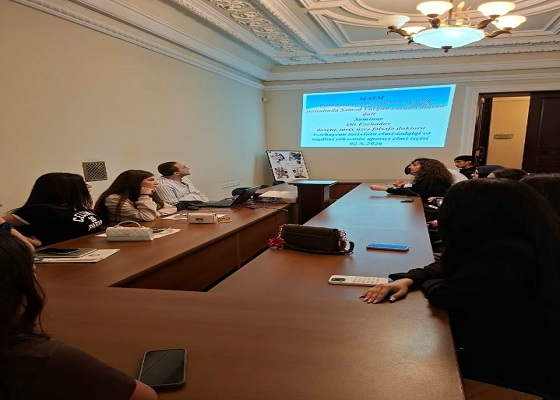
A scientific seminar dedicated to the 120th anniversary of the birth of National Poet Samad Vurgun was held at the National Museum of History of Azerbaijan. The seminar focused on the topic “Samad Vurgun’s Literary Legacy in the Newspaper Azerbaijan and the Journal Varlıq.”
Ali Farhadov, Leading Researcher at the Department of Scientific Research and Presentation of the History of Azerbaijan at the National Museum of History of Azerbaijan, Doctor of Philosophy in History and Associate Professor, delivered a presentation at the seminar.
The presentation examined the major stages of Samad Vurgun’s life and literary career, his place in the history of Azerbaijani literature, and the significance of his literary legacy in the development of public thought. It was noted that, pursuant to the Order of the President of the Republic of Azerbaijan “On the Celebration of the 120th Anniversary of National Poet Samad Vurgun” the poet’s anniversary is being commemorated at the national level.
Particular attention in the presentation was devoted to the study of Samad Vurgun’s literary work in the context of the Turkic-language periodical press of South Azerbaijan and Iran as a whole.. In this regard, the newspaper Azerbaijan, published from 1947 to 1949, and the journal Varlıq, published in Tehran from 1979 to 2014, were examined as significant sources. The importance of these publications for the study of the social, literary and cultural life of South Azerbaijan was also highlighted.
The presentation addressed publications devoted to Samad Vurgun’s literary work, as well as his contributions and public statements that appeared in the newspaper Azerbaijan and the journal Varlıq. Particular attention was given to the representation of the historical and cultural heritage of South Azerbaijan and national and spiritual values in the poet’s work. His views on the national policies of the Pahlavi regime, as well as his position on the historical and political processes affecting the Azerbaijani people, were also examined.
It was further noted that original copies of the aforementioned periodicals are preserved in the collections of the National Museum of History of Azerbaijan. These materials are of considerable value not only for the study of the history of the Azerbaijani press, but also as primary sources for research into the history of Azerbaijani literary, social and political thought.
The seminar also addressed the main features of Samad Vurgun’s national and religious worldview through an analysis of his historical drama Vagif. Particular attention was paid to the work’s thematic and ideological dimensions, the author’s interpretation of the historical figure at its centre, and the artistic treatment of national identity and historical memory.
As part of the event, slides featuring archival and material evidence related to the life and literary work of Samad Vurgun and preserved in the museum’s collections were presented. The source value of these materials for research into the poet’s life and work, as well as the history of Azerbaijani literature and public thought in the 20th century, was particularly noted.
The seminar was attended by first-year students majoring in Special Education at the Faculty of Education of Baku Slavic University and members of the museum staff. The event concluded with an academic exchange of views on the subject of the presentation. The participants also visited the museum’s permanent exhibition and familiarized themselves with materials from its collections.

The 6th International Symposium on “Historical Sites and Monuments” was held on 4–5 September 2026 in Basgal and Sulut, Ismayilli District, Azerbaijan. The symposium was dedicated to the 90th anniversary of the birth of Fazil Osmanov, a distinguished Azerbaijani archaeologist and Doctor of Philosophy in History.