


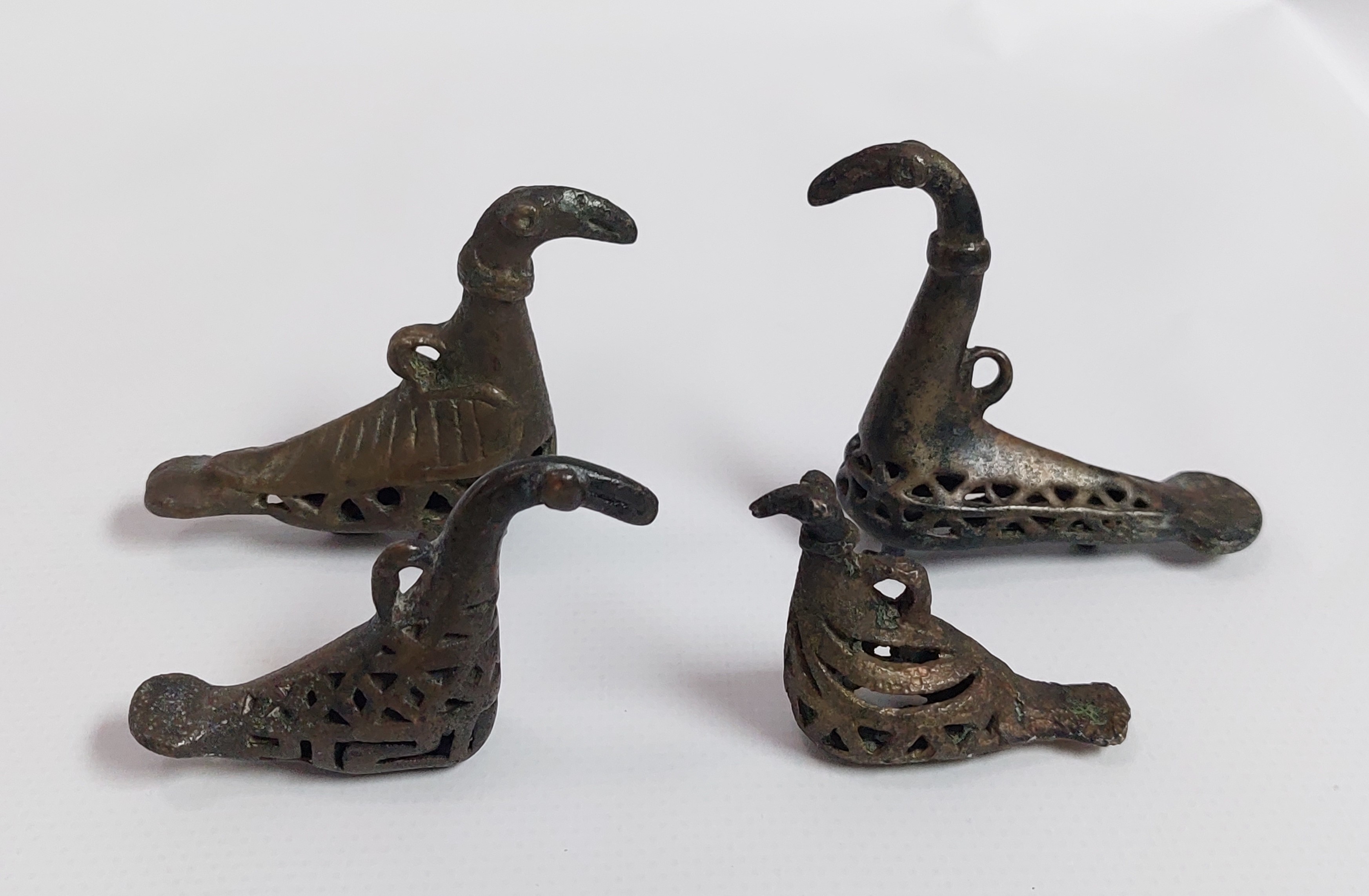
Among the ancient bronze artefacts, zoomorphic pendants are particularly noteworthy for their artistic design and refined craftsmanship. Bronze pendants of this type have been discovered at archaeological settlements and necropolises in Mingachevir, Khachbulag, Chovdar, and other sites. Distinguished by their complex and carefully elaborated forms, they attest to the advanced level of metalworking in Azerbaijan during the Late Bronze Age–Early Iron Age (12th–9th centuries BCE).
A bird-shaped pendant discovered by Davud Sharifov at Chovdar in 1926 and subsequently transferred to the museum is a characteristic example of this group, embodying its distinctive typological and stylistic features. The artefact measures 6.2 cm in height, 2.3 cm in width, and 7.7 cm in length. It is attributed to the Khojaly–Gadabay archaeological and cultural assemblage.
The object was produced through a complex, multi-stage technological process. It was initially cast using the lost-wax technique and subsequently finished through forging, trimming, cutting, and soldering.
Zoomorphic pendants of this type were probably components of female attire and may also have served a magical-symbolic function, reflecting the association of the bird motif with early religious and mythological beliefs. The presence of typologically similar examples from archaeological sites in Mingachevir and Khachbulag indicates that this was not merely a local tradition associated with the Chovdar find, but part of a broader and unified artistic and technological tradition that extended across the territory of the Khojaly–Gadabay archaeological culture.
Thus, this bronze ornament, produced using a combination of different techniques, represents an important source for the formal and typological study of metalworking and artistic craftsmanship in Azerbaijan during the Late Bronze Age–Early Iron Age, particularly the tradition of zoomorphic ornaments. In addition, the artefact has considerable scholarly and museological significance as an integral part of the history of the museum’s collection, the formation of which dates back to 1926.

Coins minted in Azerbaijan are among the important finds for the study of medieval history and monetary economy. Thanks to numismatic finds from the Hulaguid (Ilkhanid) period, it is possible to gather information about the Bazar city-mint, whose name survives only on coins.
This year marks the 585th anniversary of the birth of the great Uzbek poet, philosopher, and statesman Nizamaddin Alisher Navoi.