


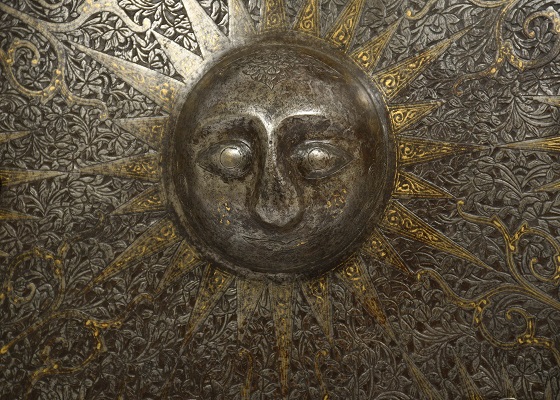
The collection of the National Museum of History of Azerbaijan includes a shield dating from the 17th to the early 18th century, distinguished by its rich artistic and decorative treatment. The shield measures 75 cm in diameter.
The central part of the shield is convex in form. The principal element of the composition is the central umbon, surrounded by smaller umbones arranged radially. An examination of the construction of the reverse side shows that the central umbon, featuring a representation of the sun with a human face, was separately fashioned and attached to the metal surface by welding. Each of the smaller umbones was likewise made separately and served to conceal the points where the rings were fastened to the inner surface of the shield. Their surfaces are also decorated with representations of the sun with a human face.
Twenty-eight rays radiate from the central umbon. The surfaces of the umbones and rays are embellished with ornamental motifs highlighted with gilding. The main surface of the shield is decorated with finely engraved vegetal ornamentation, while branch and leaf motifs are further accentuated with gilded details. The decorative composition is framed by a border bearing an inscription in Arabic script.
A brass plate bent in a circular form is attached along the edge of the shield. Its considerable size, elaborate construction, and rich artistic decoration suggest that the object served not primarily as a combat weapon but rather had a ceremonial function. In this context, it may have been used within a palace setting as a decorative element of the interior.
The image of the sun with a human face depicted on the central umbon occupies a distinctive place in the visual identity of the National Museum of History of Azerbaijan and is used as one of the principal elements of its logo.

Treasures of the Museum’s Archaeological Collection: Bronze Zoomorphic Pendants
Coins minted in Azerbaijan are among the important finds for the study of medieval history and monetary economy. Thanks to numismatic finds from the Hulaguid (Ilkhanid) period, it is possible to gather information about the Bazar city-mint, whose name survives only on coins.
This year marks the 585th anniversary of the birth of the great Uzbek poet, philosopher, and statesman Nizamaddin Alisher Navoi.