


On 15 September 1918, the military campaign to liberate Baku from Bolshevik and Dashnak forces came to an end. The liberation of the city was a significant event in the political history of the Azerbaijan Democratic Republic. Established on 28 May 1918, the republic faced an urgent task in the early months of its existence: securing control over Baku, the country’s leading political, economic, and administrative centre.
The campaign was conducted by the Caucasus Islamic Army, which was formed through military and political cooperation between the Azerbaijan Democratic Republic and the Ottoman Empire. The Treaty of Batum, signed by the two states on 4 June 1918, provided for the deployment of the 5th Caucasian Division to Azerbaijan. Commanded by Mursal Pasha, the division joined local Azerbaijani forces under the leadership of Ali-Agha Shikhlinski. Together, these forces formed the Caucasus Islamic Army, commanded by Nuru Pasha.
The decisive stage of the campaign unfolded on 14 and 15 September 1918. After days of intense fighting, Baku was taken on 15 September. The city’s capture marked an important turning point for the newly established Azerbaijani state. It made possible the transfer of the government and other central state institutions to Baku. On 17 September, the government of the Azerbaijan Democratic Republic, headed by Fatali Khan Khoyski, moved from Ganja to Baku.
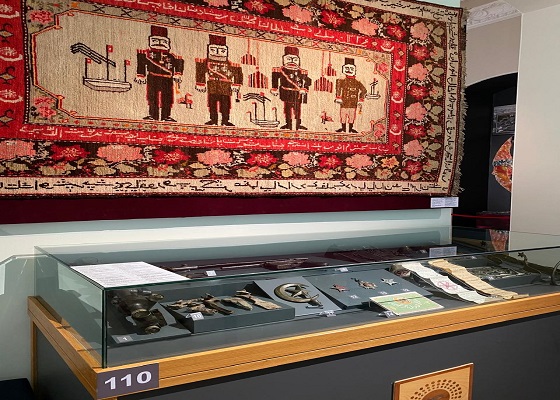
The events of September 1918 are documented in the collections of the National Museum of History of Azerbaijan through a diverse range of documentary and material sources. These include Ottoman military decorations awarded to Azerbaijani officers, archaeological finds recovered from former battle sites, and a 20th-century Karabakh carpet depicting Ottoman military commanders. The carpet was created in memory of the Caucasus Islamic Army and the events associated with its activities.
The museum objects associated with the events of 1918 provide valuable material evidence of Azerbaijan’s military and political history. They offer an opportunity to explore the circumstances surrounding the liberation of Baku and to better understand the place of these events in the emergence and consolidation of national statehood in Azerbaijan.

September 18 marks the birth of two prominent figures in Azerbaijan’s musical culture — Uzeyir Abdulhuseyn oglu Hajibeyli and Muslim Muhammed oglu Magomayev. Through their creative work and multifaceted activities, both made a significant contribution to the formation and development of professional music in Azerbaijan.
The memory of Yasen Ahmadov is also preserved at the National Museum of History of Azerbaijan.
On September 9, 2026, a specialty exam was held at the National Museum of History of Azerbaijan for applicants seeking admission to the Doctor of Philosophy (PhD) program.
On September 1, marking the anniversary of the death of the renowned philanthropist and entrepreneur Haji Zeynalabdin Tagiyev (1838–1924), staff of the National Museum of History of Azerbaijan visited his grave in Mardakan.